
ChottuLink Now Supports KakaoTalk, Samsung Internet, and Naver. Why Enterprise Brands Across South Asia Are Switching
Deep links that break inside KakaoTalk, Samsung Internet, or Naver aren't edge cases, they're dealbreakers for anyone serious about the Korean and South Asian market. Here's how ChottuLink solved it, and why enterprise brands are noticing.

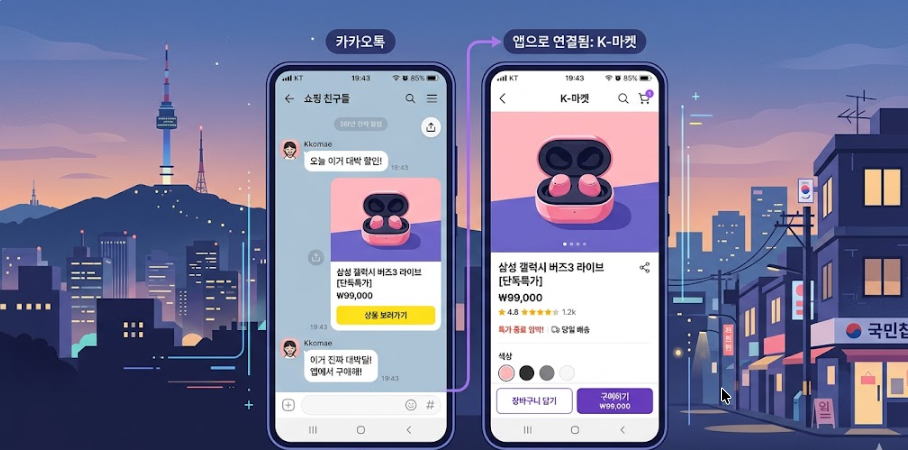
Deep links that break inside KakaoTalk, Samsung Internet, or Naver are not edge cases, they are dealbreakers for anyone serious about the Korean and South Asian market. Here is how ChottuLink solved it, and why enterprise brands are noticing.
The Problem Nobody Talks About
You build your deep links.
You test them in Chrome.
You test them in Safari.
Everything works.
Then a user in Seoul shares your link on KakaoTalk.
It opens in KakaoTalk's in-app browser.
Your Universal Link does not fire.
Your App Link does not trigger.
The user lands on a mobile web page with
no context,
no app redirect,
and no idea what to do next.
You just lost a customer.
And you did not even know it happened.
This is the reality for any app with users in South Korea.
The browser ecosystem there looks nothing like the West. Chrome and Safari are not the defaults. The surfaces where people actually click links – messaging apps, native browsers, super-apps: each behave differently. Most deep linking providers act like this problem does not exist.
South Korea's Browser Landscape Is Uniquely Fragmented
To understand what "fragmented" actually means here, it helps to go surface by surface.
KakaoTalk
KakaoTalk is South Korea's dominant messaging platform: over 47 million monthly active users in a country of 52 million.
That is essentially everyone. When someone shares a link in a KakaoTalk chat, it opens in KakaoTalk's in-app browser.
That in-app browser:
– Does not pass Universal Links to iOS the way Safari does
– Has its own JavaScript execution context that can interfere with redirect chains
– Strips certain URL parameters silently
– Does not support intent:// scheme links the way Chrome does on Android
If your deep linking provider does not specifically handle KakaoTalk's in-app browser, your links are broken for the majority of Korean mobile users.
Samsung Internet
Samsung Internet ships as the default browser on every Samsung device.
Samsung holds roughly 60% of the Android market in South Korea, which means most Korean Android users are not browsing with Chrome, they are browsing with Samsung Internet.
Samsung Internet handles Android App Links, but with real differences:
– App Link verification timing differs from Chrome, so links can appear broken during the verification window
– Custom tab behavior and intent resolution have subtle quirks
– Samsung's "Open in app" prompts behave differently than Chrome's
Naver
Naver is South Korea's largest search engine, their Google equivalent.
The Naver app has its own in-app browser with its own behaviors:
– Links opened from Naver search results go through Naver's in-app browser
– That browser handles URL schemes differently than both Chrome and Samsung Internet
– Naver's WebView configuration blocks certain redirect patterns that other browsers allow
Three major surfaces.
Three different behaviors.
Three ways your deep links can silently fail.
What "Support" Actually Means
When we say ChottuLink supports KakaoTalk, Samsung Internet, and Naver, we do not mean "we tested it once and it seemed to work."
We mean the link resolution engine detects the surface, applies the correct routing strategy, and gets the user to the right destination, every single time.
This is what that looks like in practice:
KakaoTalk In-App Browser
ChottuLink detects when a link is opened inside KakaoTalk's WebView. Instead of relying on Universal Links or App Links (which the in-app browser will not honor), ChottuLink uses a JavaScript redirect layer that:
- Breaks out of the KakaoTalk in-app browser context
- Routes the user to Safari (iOS) or Chrome/Samsung Internet (Android)
- Triggers the native deep link from there
- Falls back to the App Store or Play Store if the app is not installed
- Preserves the deferred deep link intent through the entire flow
The user taps a link in a KakaoTalk chat, installs the app, and opens to the exact screen that was shared. No context lost.
Samsung Internet
ChottuLink's Android App Link verification is optimized for Samsung Internet's verification timing.
Links resolve correctly on first click – no "Open in browser?" prompts, no verification delays, no silent failures.
Naver In-App Browser
Same pattern as KakaoTalk: detect the Naver WebView, apply the correct redirect strategy, break out to a native browser when needed, and preserve intent through the full flow.
This is not a feature toggle you enable. It is built into ChottuLink's core link resolution.
Every ChottuLink deep link – whether it is a branded short link, a QR code scan, or a shared URL : routes correctly across all three surfaces.
No additional configuration required.
Why Enterprise Brands Across South Asia Trust ChottuLink
Supporting Korean browsers is not an isolated feature.
It reflects a broader approach: ChottuLink goes deeper on platform coverage than any other provider, and that is exactly why multiple large brands across South Asia have chosen it as their deep linking backbone.
Higher App
Higher App, a fast-growing mobile platform, relies on ChottuLink to power user acquisition and re-engagement. Their users share links across WhatsApp, Telegram, Instagram, and local messaging apps, surfaces where deep links historically break.
With ChottuLink, every shared link resolves correctly, whether the recipient has the app installed or not.
YTL
YTL, one of the largest conglomerates in Malaysia and across the South Asian region, uses ChottuLink to power deep linking across their portfolio of digital products. When you are operating at YTL's scale, multiple apps, multiple markets, millions of users: you cannot afford a provider that only works in the easy cases.
ChottuLink handles their cross-app routing, branded short links, deferred deep linking, and real-time analytics across every platform they operate on.
idoki
idoki trusts ChottuLink for reliable, attributed deep links at scale. Their growth team tracks which campaigns, channels, and creatives drive installs and in-app conversions -- and ChottuLink's attribution engine delivers that data cleanly, even through deferred deep link flows where the user installs the app before the deep link fires.
The Pattern Behind the Switch
These brands did not choose ChottuLink because of a sales deck. They chose it because they tested it.
The pattern is consistent.
A team is using a legacy provider – or was on Firebase Dynamic Links before Google deprecated it.
They discover silent failures: links breaking in specific browsers, in-app WebViews, or regional messaging apps their provider does not handle.
They run a proof-of-concept with ChottuLink using the same links and same flows, but now tested across the actual surfaces their users click from.
ChottuLink works where the others do not – KakaoTalk, Samsung Internet, Naver, Instagram's in-app browser, LINE, WhatsApp, Telegram. They migrate to Chottulink.
With over 1,000 brands already on the platform, ChottuLink is quickly becoming the number one deep link provider among enterprise clients, because of routing reliability in the places where it actually matters.
What This Means If You Are Operating in Asia
If your app has users in South Korea, Southeast Asia, or South Asia, here is the reality:
Your users do not live in Chrome and Safari. They live in KakaoTalk, Samsung Internet, Naver, LINE, WhatsApp, and a dozen other surfaces. If your deep links only work in the two browsers you tested, you are losing users everywhere else.
"Works on my phone" is not a test plan.
Your engineering team tests on a Pixel running Chrome and an iPhone running Safari.
Your users are on a Samsung Galaxy running Samsung Internet, clicking a link inside KakaoTalk.
These are completely different environments.
Deferred deep linking is a must. If a new user clicks a shared link, installs your app, and lands on the home screen instead of the shared content, you have wasted the highest-intent moment in your entire funnel.
Deferred deep linking must work through every surface, including in-app browsers that intercept links.
Attribution dies when links break.
If your shared link opens a browser instead of the app, you lose the attribution chain. You cannot track which campaign drove the install. You cannot measure share-driven growth. You are flying blind.
ChottuLink handles all of this. Every link. Every surface. Every platform.
The Quiet Infrastructure That Compounds
Here is what happens when your deep links actually work everywhere:
Shared links convert. A user shares your product link on KakaoTalk. Their friend taps it, installs the app, and lands on the exact product. That is a conversion you never would have gotten with a broken link.
Campaign attribution stays clean. You know which links, channels, and campaigns drive installs and in-app actions -- even through deferred flows. Your growth team can actually optimize.
User experience holds together. No "Open in browser?" prompts. No homepage redirects. No lost context. The user goes from link to app to content in one smooth flow.
Engineering stops firefighting. Your mobile team is not debugging why links break in Samsung Internet or writing custom WebView detection code. ChottuLink handles the surface detection and routing. Your team builds features.
This compounds. Every month, more links are shared. More surfaces are covered. More installs are attributed. More users land where they should.
Winning brands are the ones whose infrastructure works in the places that matter.
Getting Started
ChottuLink supports deep linking across Android, iOS, Flutter, React Native, Unity, and Capacitor, with full coverage for KakaoTalk, Samsung Internet, Naver, and every major in-app browser.
No additional configuration is needed for Korean browser support.
Create your deep links as you normally would.
The routing engine handles the rest.
Start free – no credit card required.
Or test your existing links with the ChottuLink Deep Link Tester -- paste any URL and see exactly how it behaves across platforms. Free, no signup required.
Frequently Asked Questions
Does ChottuLink support deep linking inside KakaoTalk's in-app browser?
Yes. ChottuLink detects when a link is opened inside KakaoTalk's in-app WebView and applies a JavaScript redirect strategy that breaks out to the native browser, triggers the deep link or App Store redirect, and preserves deferred deep link intent through the full install flow. No additional configuration is needed.
How does ChottuLink handle deep links in Samsung Internet?
ChottuLink's Android App Link verification is optimized for Samsung Internet's verification behavior. Links resolve on first click without "Open in browser?" prompts or verification delays. Since Samsung Internet is the default browser on Samsung devices – which dominate the Korean Android market – this is critical for reliable deep linking in South Korea.
Do ChottuLink deep links work when opened from Naver search results?
Yes. Naver's in-app browser has its own WebView configuration that blocks certain redirect patterns. ChottuLink detects the Naver in-app browser context, applies the correct routing strategy, and ensures the user reaches the app or the App Store with full deferred deep link support.
Which enterprise brands use ChottuLink for deep linking?
Multiple large brands across South Asia trust ChottuLink, including Higher App, YTL, and idoki. With over 1,000 brands on the platform, ChottuLink is quickly becoming the number one deep link provider among enterprise clients – chosen for its routing reliability across fragmented browser ecosystems.
Is ChottuLink a replacement for Firebase Dynamic Links?
Yes. Google deprecated Firebase Dynamic Links, and ChottuLink is a direct, production-ready replacement. It supports all the same platforms (Android, iOS, Flutter, React Native, Unity, Capacitor) with additional coverage for regional browsers and in-app WebViews that Firebase never handled well.
Do I need to configure anything special for Korean browser support? No. ChottuLink's Korean browser and in-app browser support is built into the core link resolution engine. Every ChottuLink deep link – branded short links, QR codes, shared URLs – automatically routes correctly across KakaoTalk, Samsung Internet, and Naver without any extra setup.
Does deferred deep linking work through KakaoTalk and Naver in-app browsers?
Yes. When a user clicks a ChottuLink deep link inside KakaoTalk or Naver and does not have the app installed, ChottuLink preserves the link intent through the redirect, App Store install, and first app open. The user lands on the exact screen that was shared – not the home screen.