
How to Measure Influencer Marketing ROI for Apps
Installs are not revenue. Measure influencer ROI for an app on net revenue, see what iOS and Android let you track, and work one campaign through to its payback month.


You paid a creator $5,000, the dashboard shows 2,000 installs, and the question in the room is whether it paid back. The install number cannot answer that.
To measure influencer marketing ROI for an app, compute (net revenue − cost) ÷ cost × 100 on the revenue that creator drove over a horizon you name before you launch. That is net revenue, not profit. "+206%" says nothing on its own; "+206% over 12 months on net subscription revenue" is a figure someone can check. The work is deciding what counts as revenue, over what period, and which method can see it.
We build ChottuLink, a deep linking and link attribution tool, so where it helps with one of the steps below, we'll point it out.
Count net revenue over a horizon you set first
Count every cost: creator fees, product or shipping you sent, any agency or platform fee, discount codes you funded, and the internal time spent running the campaign. Leave a line out and the ROI looks better than it was.
Revenue is where app campaigns diverge from a website. Two adjustments matter before you compare anything:
- Net, not gross. The store takes its commission before you see the money, so gross revenue overstates the return. As of October 2026, Apple's commission on digital sales is 30%, or 15% under the Small Business Program for developers who earned up to $1M in proceeds the prior year; an auto-renewable subscription pays 70% net in a subscriber's first year and rises to 85% once they have a year of paid service. Google Play charges auto-renewing subscriptions 10% plus a 5% billing fee (about 15% in total) and other in-app purchases 15% on your first $1M of annual earnings, more above it. Apply your own rate.
- A named horizon. A one-off purchase lands in a session; a subscription keeps arriving monthly. A return figure means nothing without the period it covers.
Why an app is harder to measure than a website
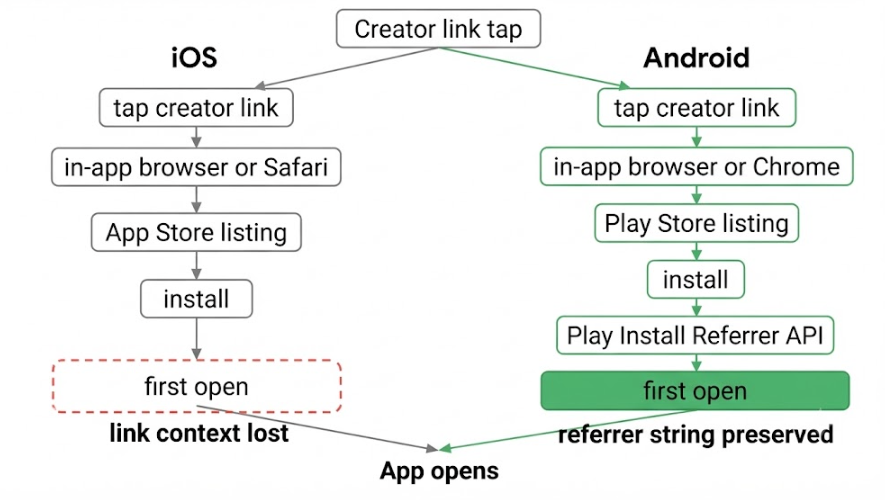
The click and the outcome happen in different places. A user taps a creator's link in a browser or an in-app browser, lands on a store listing, installs, and only then opens the app. Two platform facts decide what you can trace:
- On iOS, a universal link opens your app when it is installed and the browser when it is not. Apple's universal-link documentation covers where the link goes and describes no channel that carries the clicked link into the first launch after an install.
- On Android, for Play Store installs, the Play Install Referrer API passes the referrer string from the Play Store URL into the app, along with click and install timestamps.
That difference shapes what each method is worth. On Android a UTM survives the install if it is put in the Play Store URL's referrer parameter. On iOS it typically does not reach the app on a first install. A promo code identifies whoever redeemed it, and no one else.
What each method can actually see
Split the problem in two: linking a person to a creator, then turning that into revenue. Most app teams need one method from the first group and their own cohort in the second.
Linking a person to a creator
| Method | What it identifies | Where it works | What it misses |
|---|---|---|---|
| Promo / offer code | The buyer, at redemption | In-app redemption or web checkout | People who buy without redeeming |
| UTM / tracking-link click | The click source | Web landing pages; Android installs via the referrer parameter | The iOS first install |
| Deferred deep link | The click, carried through the install | Android (deterministic, Play Store installs) and iOS (signal match) | Reinstalls; sessions where there was no click |
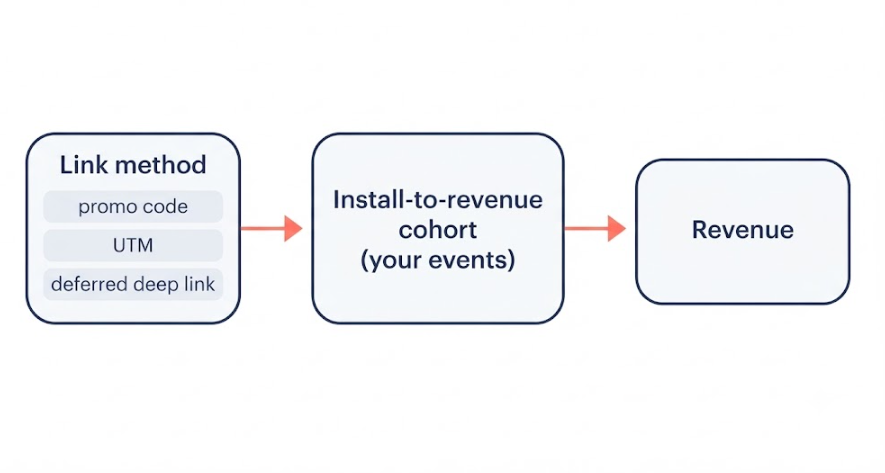
Turning a click into revenue is a separate layer: your own event cohort, recording what each attributed user buys over time.
For an organic creator post that links to your app, the decision is small: one unique link per creator, then measure revenue from your own events. One wrinkle: Instagram and TikTok open links in their own in-app browsers, which intercept the link before the operating system can hand it to your app, so a tap can land on your web fallback instead of the app. ChottuLink detects the in-app browser and hands off automatically; the Instagram deep link guide covers the mechanics.
A worked example
Say you pay one creator $5,000 all-in. The link records 2,000 installs and 500 sign-ups; 150 of those sign-ups become subscribers at $9.99 a month. The 30% sign-up-to-paid rate is a placeholder for your own number; the figures below are for the arithmetic, not a benchmark, and they assume every subscriber pays from month 1. Trials, refunds and tax are not modelled.
| Metric | Value |
|---|---|
| Cost | $5,000 |
| Installs | 2,000 |
| Cost per install | $2.50 |
| Sign-ups | 500 |
| Cost per sign-up | $10.00 |
| Paying subscribers | 150 |
| Cost per paying subscriber | $33.33 |
| Monthly revenue, gross | $1,498.50 |
| Monthly revenue, net | $1,273.73 |
The net figure is the 85% kept by a Google Play subscription or a Small Business Program developer. On a standard iOS rate, 70% net in a subscriber's first year, the same cohort nets $1,048.95 a month.
Run the return at two horizons on net revenue:
- 90 days: about $3,821 net, so ROI is about −24%.
- Payback: the campaign crosses $5,000 net during month 4.
- 12 months, everyone stays: about $15,285 net, so ROI is about +206%.
- 12 months, a third churn (50 cancel after month 3): about $11,464 net, so ROI is about +129%, and payback slips to month 5.
On the 30% iOS rate the same no-churn campaign pays back in month 5 and returns about +152% over 12 months.
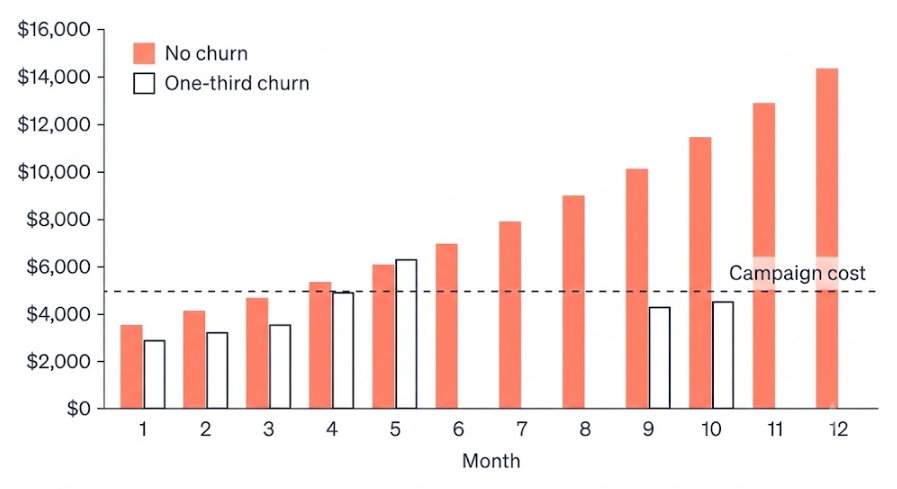
Retention moves the answer more than anything else, so compare creators on it. Three creators, each paid $5,000:
| Creator | Installs | Cost per install | Subscribers | 12-month net revenue | ROI | Payback |
|---|---|---|---|---|---|---|
| A | 2,000 | $2.50 | 150 | $15,285 | +206% | month 4 |
| B | 4,000 | $1.25 | 160 | $10,190 | +104% | month 5 |
| C | 1,000 | $5.00 | 120 | $12,228 | +145% | month 5 |
A and C keep every subscriber for the year; half of B's cancel after month 3. B looks the strongest on installs, twice A's at half the cost, and returns the least: +104% against C's +145% and A's +206%.
Those columns are the template for each campaign.
Setting it up so the numbers are real
Put one link on each creator's post. Reusing one link merges the creators into a single row, so you cannot compare them. ChottuLink's unlimited deep links carry no per-link cap, and billing is by monthly active users rather than per link (pricing, as of October 2026). Tag each link with UTMs; the free UTM Builder writes the parameters for you.
Close the install gap. Deferred deep linking preserves the clicked destination across the store install, so a first-time installer lands on that content instead of the home screen. ChottuLink matches the click to the first open using device and network signals such as IP address, OS version and screen dimensions, and does not use IDFA; on Android it also matches deterministically through the Play Install Referrer. The window is up to two hours between click and first open, and a first open after that does not match at all. IP-based matching can also fail when the address changes between the click and the open, which then appears in the report as an organic install. The step-by-step guide walks through the setup.
Record the revenue. A subscription renews without anyone opening the app, and that event reaches you through Apple's App Store Server Notifications or Google Play's real-time developer notifications, not through an in-app call. ChottuLink records conversion and revenue events from its in-app SDK only, so a renewal the app never sees is not counted; keep your store billing data beside the attributed figure for the multi-year picture.
Report revenue and lifetime value per creator. ChottuLink's attribution follows click → install → sign-up → revenue per link and campaign, and gives you revenue by link and campaign plus lifetime value per attributed customer, as columns; you still add the creator's cost yourself.
When a link layer is enough, and when it isn't
For organic creator links, referrals, and anything else you can put a link behind, a link-attribution layer usually covers it: it ties a click to an install, a sign-up and revenue events. Once you run paid ads across several networks, you need a mobile measurement partner, because ad attribution, fraud checks and ATT live there. On iOS the ad network matches the install through SKAdNetwork or AdAttributionKit, and the postbacks carry no user- or device-specific data. See whether you need an MMP.
ChottuLink is not a paid Meta, Google or TikTok attribution tool. If your creator content runs as boosted ads behind those networks, measure that spend with the platform's own tools or an MMP. For the organic side, tracking app installs with deep links is where the link layer does the work.
Reading the results
Divide what a subscriber is worth by what they cost. In the example, $33.33 per subscriber against roughly $102 of net 12-month value is about 3×, and the churn case falls to about 2.3×. How much headroom you need is your call; the value is net of store commission, not margin.
Link attribution misses conversions with no click, so pair each creator link with a promo code and a "how did you hear about us?" survey. The three totals will not match, and codes always undercount because redeeming one is optional, so treat the survey as the check on the link rather than a replacement for it.
Assisted value, view-through exposure and brand searches a creator triggered do not attach to a link, so a link-attributed figure understates a creator whose main effect is awareness. Reach, engagement and earned media value (EMV) measure that exposure rather than money, and belong beside the ROI figure, not inside it. To size the exposure, run an incrementality check: hold back a region, or compare a creator-off period with a creator-on one, and treat the difference as the value the link could not attribute.
FAQ
What is a good ROI for influencer marketing? Any ROI above zero at your horizon, with the payback month inside the window your cash flow can absorb. In the example, the no-churn case reaches payback in month 4 at 85% net, and the churn case in month 5. Published "average ROI" figures are usually undated and undefined, so they make a poor target.
Is this ROI or ROAS? The formula above is ROI: it subtracts the cost. ROAS is revenue ÷ cost without the subtraction, so the same campaign reads higher; pick one and use it for every creator.
Next steps
- Set the horizon and the churn assumption before you launch, and write both into the campaign brief.
- Create one link per creator, with UTMs, before the posts go live.
- Record purchase and sign-up events in-app, and pull subscription renewals from your store billing data.
- Re-run the same calculation at 90 days and 12 months, and keep both numbers.