
What Is Mobile Attribution? A Complete Guide for App Founders (2026)
Your install numbers are going up, but you cannot say why. Mobile attribution is the answer, and most early-stage apps are overpaying for it. This post covers what it actually is, how the three attribution models differ, and when a full MMP is worth the cost.

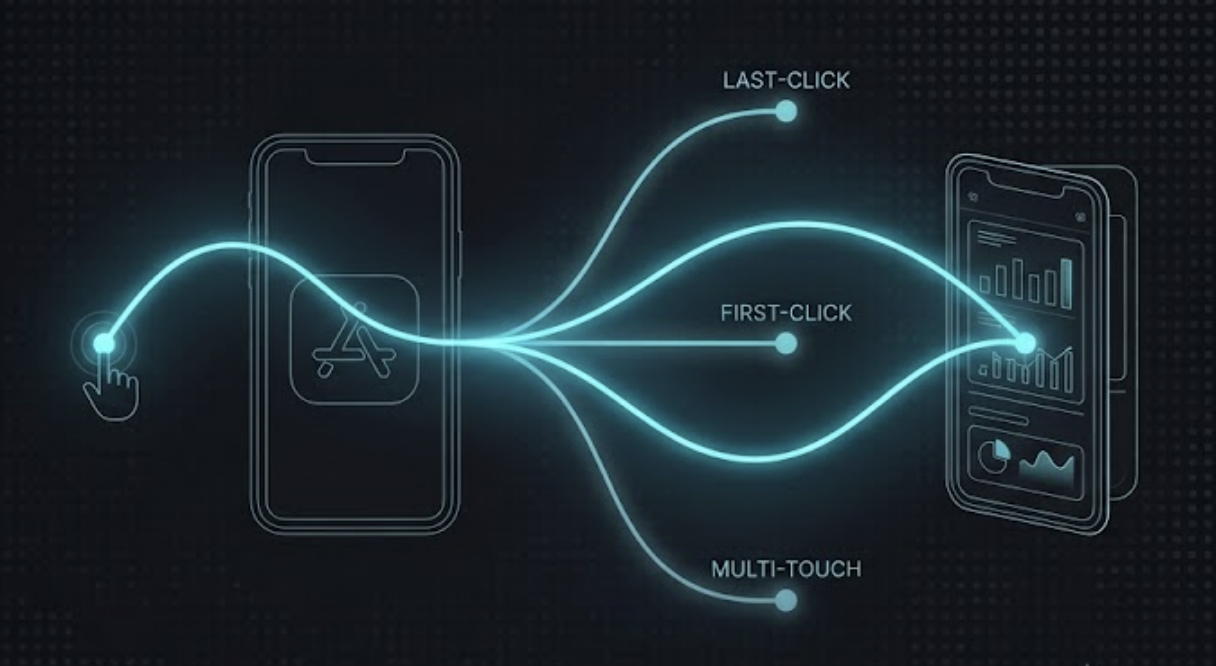
Your install numbers are going up.
That part is easy to see.
What is harder is knowing why.
You are running ads, working with influencers, sending emails, printing QR codes on packaging. Installs are happening. Which campaign actually caused them is a separate question. So is which influencer's audience installs and sticks around, versus just watching and scrolling past. So is which QR code is worth reprinting, and which one is dead weight on a box nobody scans.
Without answers to those questions, your install count is a vanity metric. Mobile attribution is what turns it into something you can act on.
What Mobile Attribution Actually Means
Mobile attribution connects an app install, and whatever the user does afterward, back to the specific marketing touch that caused it. Put simply: it answers "which click led to this install, and what did that person do next?"
On the web, this problem is largely solved. A cookie sits in the browser, follows the user from ad to landing page to checkout, and the whole journey stays in one continuous session. Mobile does not get that luxury. A user taps an ad, gets routed to the App Store or Play Store, installs, and opens the app. By the time they open it, they have left the web environment entirely and come back through a completely different one. No cookie survives that trip. The click and the install are two separate events that, on their own, have no way of knowing about each other.
Attribution platforms close this gap one of two ways. Deterministic matching captures a unique identifier, a link ID, a device token, an install referrer value, at click time and reads it back at app open. If the same identifier shows up on both ends, that is a confirmed match, not a guess. Probabilistic fingerprinting works differently: signals like device type, OS version, IP address, and timestamp get captured at click time and compared statistically against signals seen at install time. Close enough, within a tight time window, counts as a match. That is an educated guess, not a certainty, and it gets fuzzier the more privacy restrictions strip away the signals it depends on.
Most real-world attribution setups use both. Deterministic matching runs wherever a platform makes it possible, such as Android's Play Install Referrer, and fingerprinting fills in everywhere else, especially on iOS.
The Three Attribution Models
Knowing that an install came from a link is only half the story. When a user's journey touches multiple marketing sources before they convert, an ad, then an email, then a QR code, you need a rule for deciding which one gets the credit. That rule is called an attribution model, and it is not a footnote. It decides which campaigns look like they are working and which ones get cut.
| Model | How credit is assigned | Best for | Watch-out |
|---|---|---|---|
| Last-click | 100% of the credit goes to the final touch before the install or conversion | Simple setups, retargeting-heavy funnels | Inflates the value of the last nudge (a retargeting ad, a reminder email) and erases everything that built awareness earlier |
| First-click | 100% of the credit goes to the very first touch that brought the user in | Measuring top-of-funnel/awareness campaigns | Makes nurture and retargeting look worthless, even when they are what actually closed the install |
| Multi-touch | Credit is split across every touch in the journey, commonly weighted toward the first and last touch with a smaller share in between | Longer funnels with several channels involved | More accurate, but needs more data and more setup to mean anything |
None of these is "correct" in the abstract. Each is a policy choice, and the one you pick shapes which channels get more budget next quarter. A team on last-click keeps over-funding retargeting. A team on first-click keeps over-funding top-of-funnel awareness spend that may not be doing the actual work of converting. Most teams start with last-click because it is simple to reason about, then move to multi-touch once they have enough volume across enough channels for the added complexity to actually pay off.
Privacy and iOS: Why Attribution Got Harder
For years, attribution on iOS leaned on the IDFA (Identifier for Advertisers), a device-level ID that made deterministic matching straightforward. Apple's App Tracking Transparency (ATT) framework changed that. Apps now have to explicitly ask for permission to access the IDFA, and most users say no.
The practical effect is that deterministic, ID-based matching on iOS became the exception rather than the rule. Attribution providers shifted toward fingerprinting and Apple's own privacy-preserving SKAdNetwork for ad-network-level reporting. Both approaches work, but both are inherently less exact than a straightforward ID match. If you are comparing install numbers between Android and iOS and the iOS side looks fuzzier or slightly lower, that is not necessarily your campaigns underperforming. It may just be attribution doing its best under real privacy constraints.
This is also why the matching method a platform uses matters more than it sounds. Deterministic matching, where it is available (Android's Play Install Referrer, or a link ID your own platform controls end to end), is worth more than fingerprinting alone, because fingerprinting is the piece that erodes fastest as browsers and operating systems keep tightening privacy defaults.
Do You Actually Need a Full MMP?
Once teams understand attribution, the next question is usually whether they need AppsFlyer, or Adjust, or Branch. For most early-stage apps, the honest answer is not yet.
A full Mobile Measurement Partner (MMP) is built to solve a harder problem: attributing installs across dozens of paid ad networks at once, with automatic data pulls from each network, fraud detection at scale, and cross-device identity graphs. That is real infrastructure, and it costs real money, typically $500 to $3,000 or more per month, plus real setup time, often weeks.
If your traffic is coming from channels you already control, your own ads, your own influencer partnerships, your own email and QR campaigns, you do not need that. You need link-level attribution: knowing which of your links drove which install, lead, and sale. That is a much smaller problem, and it is one that modern deep linking platforms like ChottuLink solve natively, without a separate MMP contract.
| Deep linking + attribution (e.g. ChottuLink) | Full MMP (AppsFlyer, Adjust, Branch) | |
|---|---|---|
| Install attribution | Yes | Yes |
| Lead & conversion tracking | Yes | Yes |
| Revenue attribution per link | Yes | Yes |
| Deep linking (right screen on first open) | Yes, core feature | Add-on or separate integration |
| Paid ad network auto-pull integrations | No | Yes (Meta, Google, TikTok, etc.) |
| Fraud detection at scale | No | Yes |
| Cross-device attribution graphs | No | Yes |
| Setup time | Minutes (SDK init() call you already make) |
Days to weeks |
| Price | Starts from $39/mo | $500–$3,000+/mo typical |
The honest line is this: use lightweight, link-level attribution when your traffic comes from sources you control. Reach for a full MMP when you are running paid spend across multiple ad networks and need automatic, network-level reporting at scale. Plenty of teams end up running both, a deep linking platform for owned and earned channels alongside a lighter MMP tier for paid network data, but most do not need to make that jump until they are well into paid scale.
Closing the Loop: Attribution Feeding Ad Platforms Back (Meta CAPI)
Attribution data does the most good when it does not just sit in a dashboard. It matters more when it feeds back into the ad platform that spent the money, so the algorithm gets smarter about who to target next.
This is what the Conversions API (CAPI) does for Meta ads. When someone converts, whether that is a purchase, a signup, or a lead, after clicking through a link, that conversion event can be sent server-to-server straight back to Meta. ChottuLink does this automatically for links used in Meta campaigns. The same click ID captured for attribution is what carries the conversion signal back.
Server-side CAPI events are not blocked by ATT prompts, ad blockers, or cookie expiry the way browser-side pixel tracking is, which is what matters beyond the reporting itself. Meta's algorithm keeps learning from real conversions even on traffic where client-side tracking has quietly gone dark. That is the difference between attribution as a report you read once a week and attribution as plumbing that actively improves your ad spend in real time.
This topic deserves its own deep dive, but the short version holds: teams running Meta campaigns with only pixel tracking wired up are leaving signal on the table that a CAPI-connected attribution setup would otherwise recover.
How to Get Started
Three steps cover it, whether you are setting this up for the first time or replacing a spreadsheet-and-guesswork process. Start by creating links for what you want to measure: a unique link per ad creative, per influencer, per QR placement, per email segment, with UTM parameters so the source stays unambiguous later. Next, add the SDK to your app. Attribution typically runs off the same init() call you are already making for deep linking, so no separate SDK is needed, and install matching is covered automatically. Last, send lead and conversion events as they happen: a signup, a trial start, a purchase, whatever counts as a real outcome for your product. That last step is what turns "which link got clicks" into "which link made money."
From there, watch the dashboard: clicks, installs, leads, and revenue, all tied back to the specific link and campaign that started the journey. See how ChottuLink tracks installs and how to attribute installs to specific influencers for worked examples of this in practice.
Frequently Asked Questions
What Is the Difference Between Deep Linking and Attribution?
Deep linking sends a user to a specific screen inside your app, even through an install. Attribution tells you which marketing touch caused that click, install, and any conversion that followed. Deep linking is about the destination. Attribution is about the source.
What Is the Difference Between Mobile Attribution and a Mobile Measurement Partner (MMP)?
Mobile attribution is the general capability of connecting installs and conversions back to a marketing source. An MMP (AppsFlyer, Adjust, Branch, Singular) is a dedicated enterprise platform that does attribution at scale across every paid ad network, with fraud detection and cross-device graphs built in. You can get meaningful attribution without an MMP if your traffic comes from links you control.
Does Mobile Attribution Work Without SDK Integration?
Click and web-side tracking can work without an SDK, but matching an install back to the click that caused it requires an SDK call at app open. That call is what reconnects the device across the App Store or Play Store gap.
Is Mobile Attribution GDPR/CCPA Compliant?
It can be, depending on what the platform matches on. Attribution built around a link ID rather than personal identifiers (email, device ID, advertising ID) avoids most of the PII handling that triggers stricter consent requirements. Always check the specific platform's data practices.
What Counts as a Tracked Event in Mobile Attribution?
Typically three things: a lead (signup, trial start, cart add), a conversion (purchase, subscription), and any custom event you define (video watched, level completed). Clicks and installs are unlimited and do not count against the same quota.
Does Mobile Attribution Data Connect to Meta or Google Ad Accounts, or Does It Just Stay in a Dashboard?
It depends on the platform. Some attribution tools only report internally. Others, including ChottuLink, forward conversion events server-side to Meta's Conversions API, so the ad platform's own algorithm learns from real conversions instead of just clicks and installs.
Start Tracking What Actually Works
You do not need a $500-a-month MMP contract to know which links are making you money. Deep linking with attribution built in gets most early-stage apps there in minutes, not weeks.