
How to Choose a Deep Linking Tool That Fits Your Stack (2026 Buyer's Guide)
Two questions set your category and seven criteria decide fit, from SDK coverage and Apple's ATT rule on device signals to Firebase migration and dated pricing. A sourced buyer's guide to deep linking tools.

The deep linking tool that fits your stack is decided by two questions before you compare any brands: do you own the app and control its release cycle, and do you need to attribute the click to an install, a signup, or revenue? Teams that own the app and grow through organic, referral, or influencer traffic can usually run on a deep-linking platform without an MMP; teams buying paid media across many networks need an MMP. Seven criteria then narrow the field: SDK coverage, resolution reliability, in-app-browser handoff, Apple's ATT rule on device signals, attribution depth, cost model, and migration path. Every price in this guide is dated to October 2026.
ChottuLink is our product.
Two questions set your category
- Do you own the app and control its release cycle? If you do, you can ship an SDK. If you do not (you are marketing someone else's app, or running links into apps you don't build), you are limited to a link-routing tool that works without one.
- Do you need to attribute the click to an install, a signup, or revenue? If you only need users to land on the right screen, a routing tool is enough. To know which campaign drove the result, you need a platform that measures the whole funnel.
Those answers produce three buying paths. Pick the path first, then compare tools inside it.
| Buying path | Fits when | Integration cost | Privacy exposure |
|---|---|---|---|
| No-SDK link tool | You don't own the app, or you need links live today | None (hosted redirect layer) | No in-app identifier |
| Deep-linking platform (SDK) | You own the app and need reliable routing plus the install gap closed | SDK integration | Depends on how it resolves the install gap (see the privacy test) |
| MMP + deep linking | You run paid media and need measurement across many ad networks | SDK plus partner integrations | Attribution identifiers |
A seed-stage app routing an email campaign to a signup screen does not need an MMP. A performance team spending across Meta and Google cannot run on a routing tool alone.
The seven criteria that decide fit
Each candidate has to clear all seven. Order matters: the first three remove more tools than price does.
1. Stack fit: does it ship the SDK you actually use?
The platform-standard layer opens your app: on iOS a Universal Link, which requires an apple-app-site-association file served from /.well-known/apple-app-site-association on your domain (Apple); on Android an App Link, a verified app-to-website association supported on Android 6 and later, with Dynamic App Links added in Android 15 (Android Developers). Google Search supports both (Google Search Central).
A deep linking tool sits on top of that: it configures the association files, generates links, and handles the cases the OS does not. Its SDK has to match your codebase.
| Your app | What to require |
|---|---|
| Native iOS / Android | First-class Swift and Kotlin SDKs |
| React Native, Flutter | Official (not community) SDKs for the framework |
| Unity, Capacitor/Ionic | An SDK for the engine or framework you ship |
| Web-to-app only | No SDK required; a redirect layer with smart banners |
If a vendor has no Unity or Capacitor SDK, it fails this test for a game studio or a hybrid app regardless of price.
Two developer-facing checks belong to this criterion as well:
- Programmatic control. A REST API to create and update links, webhooks for click and install events, and a data export path. A platform with no API suits a marketing-only workflow; product teams should require one.
- Onboarding. Self-serve signup you can test in an afternoon, or a sales call before you can create a single link.
2. Resolution reliability
A deep link is a redirect, and the redirect has to answer before the user gives up. Ask any vendor for a published uptime commitment and a redirect latency figure, then for its behavior in the four cases that break links in production: Apple's CDN has not yet fetched a new association file, the app is installed but the link points at a screen that no longer exists, the in-app browser strips the URL, and a campaign puts 100,000 clicks on one link in an hour. A vendor that will not put an uptime or latency number in writing, or cannot describe what its fallback does when the app is missing, is a production risk you are choosing blind.
3. In-app-browser handoff
Links that work in a browser can fail inside the Instagram or TikTok in-app browser, where Universal Links and App Links are frequently suppressed. A tool that detects the in-app browser and hands the user off to the system browser or the store is worth a line on your shortlist, because this class of failure is most visible on social and influencer traffic. Our guide to Instagram deep links covers the mechanics.
4. The privacy test: how does it close the install gap?
This is the criterion that has changed in the last few years. The install gap is the moment a new user clicks a link without the app, installs it, and opens it. The question is where the original destination comes from.
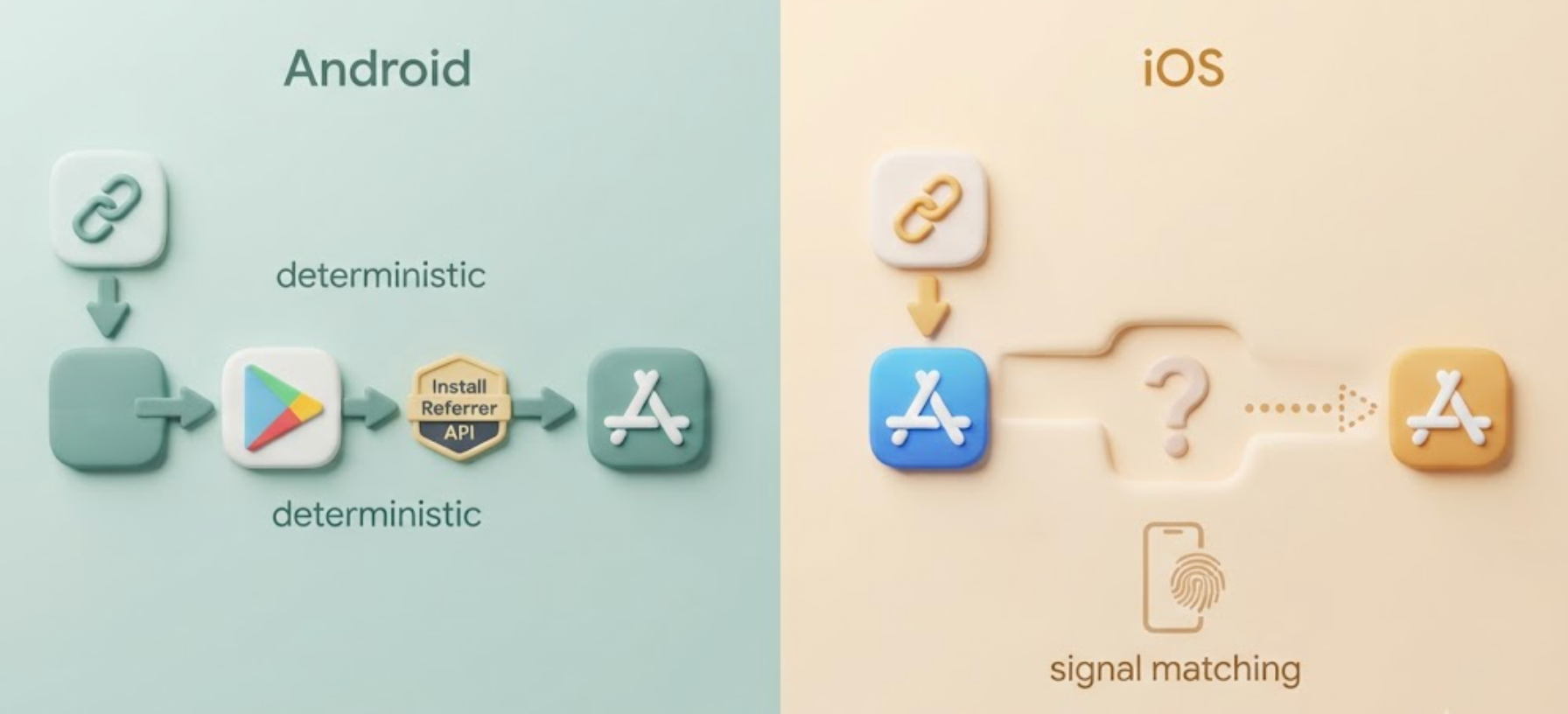
On Android there is a clean answer. The Google Play Install Referrer API returns the referrer URL, the referrer click timestamp, and the install begin timestamp directly from the store, so the originating link comes back from a first-party source (Android Developers). Google documents this API for Google Play only, so installs from other Android stores fall outside it.
On iOS there is no equivalent first-party channel for a fresh install. Many vendors bridge that gap by matching device and network signals captured at click and again at first launch. Apple's rules bear directly on that practice:
- From iOS 14.5, an app needs App Tracking Transparency (ATT) permission to track a user or access the advertising identifier (Apple).
- Apple states that you may not derive data from a device for the purpose of uniquely identifying it, and lists the user's device and its configuration and the user's network connection among the data that rule covers. Apps, and the SDKs they reference, may be rejected from the App Store for it (Apple).
- ATT permission is required for third-party deep-linking or deferred-deep-linking tools that pass unique identifiers or create a shared identity of the user between apps from different companies for ad targeting, ad measurement, or sharing with a data broker (Apple).
The purpose in that last rule materially affects how much risk you are taking on. A vendor that only routes users and reports back to you sits in a different place from one that feeds a shared identity for ad measurement. Read the rest of this section as a reading of Apple's published rules, not legal advice.
Avoiding the IDFA is not a safe harbor from the unique-identification rule above. The question is whether the signals a vendor reads, taken together, amount to identifying a device. ChottuLink uses network and device signals that Apple permits, still the question applies to ChottuLink as much as to anyone else. Read each vendor's current page and answer it yourself:
- Which signals does the SDK read to resolve the iOS install gap? ChottuLink answers this in its own feature documentation, and so should every vendor on your shortlist.
- How long are those signals kept, and are they shared with anyone else?
- Does the SDK trigger a tracking permission or a privacy-manifest declaration in your app?
- Does the vendor pass identifiers or build a shared identity for ad targeting or ad measurement?
If a vendor will not answer those in writing, you cannot assess the risk, which means you are accepting it without knowing its size.
5. Attribution depth: routing tool, platform, or full MMP
A pure routing tool gets the user to the right screen and stops. The moment you add a separate analytics stack, two systems have to agree on the same install, and the mismatch shows up as duplicate reports and reconciliation work. A platform with link-level attribution ties clicks, installs, and conversions together without an MMP contract; a full MMP is for paid acquisition across many partners, where you need network postbacks, fraud tooling, and cross-channel measurement. If you are not sure which side you are on, read our breakdown of whether you actually need an MMP before you add the cost.
ChottuLink's Link Attribution ships on every paid plan. You POST a conversion event (a lead or a purchase) from your own backend; ChottuLink matches it to the originating link click and the dashboard shows revenue per link, with no SDK changes, no second vendor, and no reconciliation layer. That is not a roadmap item; it runs in production today.
6. Cost model: normalize the unit before you compare
Quotes are not comparable as printed, because vendors bill on different bases: per monthly active user (MAU), per converted install, per link, or a custom annual quote. A tool billed per conversion and a tool billed per MAU can swap places depending on your volume.
The dated state of the market (as of October 2026):
| Vendor | Billing basis | Public figure | Source |
|---|---|---|---|
| AppsFlyer (full platform) | Per conversion | Zero plan free and not for paid activities; Growth pay-as-you-go; 12,000 free conversions in year one, then $0.07 per conversion (their definition of a conversion includes installs, re-engagements and re-attributions) | AppsFlyer pricing |
| AppsFlyer OneLink, the Deep Linking Suite | Custom per tier | Sold standalone; free Zero tier for owned media, with no deferred deep linking and no branded links, which start on paid tiers | AppsFlyer deep linking pricing |
| Branch | Custom per tier | Basics / Essential / Enterprise; no list price published; free trial on Basics | Branch pricing |
| Adjust | Per conversion | Base free for the first year, up to 1,500 conversions a month (18,000 a year); Core up to 250,000 annual conversions; Enterprise over 2,500,000 annual conversions; no list price published | Adjust pricing |
| ChottuLink (as of October 2026) | Flat tiered (MAU ceiling) | Free $0 (up to 25K MAU); Indie $19/mo (up to 75K); Growth $39/mo (up to 150K); Scale $99/mo (up to 500K) | ChottuLink pricing, FAQ |
We pulled every figure in that table from the source linked in its row on October 8, 2026.
The units differ, so run the arithmetic on your own volume. A per-conversion plan that charges $0.07 per converted install is cheap at low volume and grows linearly with success. A flat tiered plan like ChottuLink's moves up only when you cross a MAU ceiling, and two limits sit on top of it: tracked conversion events (the trackLead, trackConversion, and custom trackEvent calls that make attribution work) are capped at 10,000 a month on Growth and 50,000 on Scale, while links, clicks, and app installs stay unlimited on every plan (ChottuLink pricing, plan cards and "What is a Tracked Event", as of October 2026). ChottuLink's own pages disagree about where the other limits start: the plan cards put custom domains on Growth and webhooks on Scale, the Free-plan FAQ claims a custom branded domain on the free tier, and the Indie card lists both "App install analytics" and "no attribution / tracking events". So read the plan cards against your own use case and confirm in writing before you choose a plan. On the cards as published, click-to-signup and click-to-revenue work needs Growth rather than Indie. Branch and Adjust do not publish per-unit prices, so you cannot compare them without a quote, which is itself a reason to ask early.
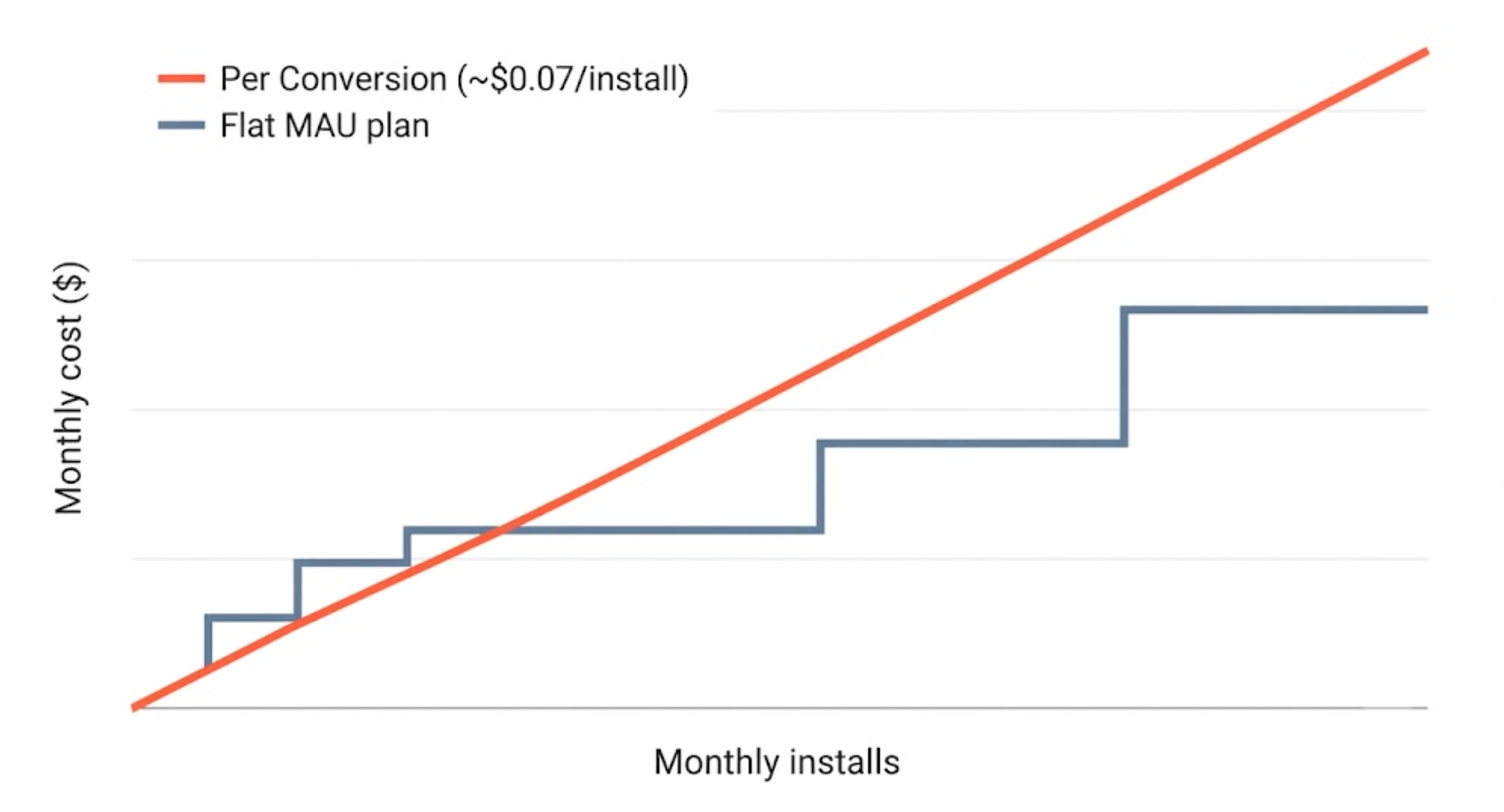
Illustrative, not a quote: at 100,000 conversions a month the published AppsFlyer rate of $0.07 comes to about $7,000 a month once the one-time 12,000-conversion allowance is used up.
7. Migration path (Firebase is gone)
Firebase Dynamic Links shut down on August 25, 2025. All links it served, on custom domains and page.link subdomains alike, stopped working and now return an HTTP 404 to end users. Google never offered a way to keep or transfer the automatically provisioned .page.link domains (Firebase).
Google's guidance splits by need. Teams that only care about deep-linking into an app that is already installed are pointed to App Links and Universal Links, the platform-supported mechanisms. Teams that need full feature parity with Firebase's feature list are pointed to third-party vendors, and Google names Adjust, Airbridge, AppsFlyer, Bitly, Branch, Kochava, and Singular (a list Google says it has not vetted) (Firebase).
Ask any candidate:
- My old links:
page.linklinks are dead and those domains cannot be transferred. Only links that ran on a custom domain I own can come back, by pointing that domain at the new provider. Can you do that? - Can I migrate without shipping a new app version, or does the SDK change force a release?
- Can I run my own branded domain, so future links are not tied to the vendor's subdomain?
Running links on your own domain is the durable answer, because the Universal Links and App Links association files live on your domain. Our Firebase migration guide walks through the mechanics.
A worked decision example
A mid-size e-commerce team ships a Flutter app, runs paid Meta ads, and sends email and SMS to a mobile web page that pushes visitors into the app. They own the app and need to know which channel drives purchases.
Apply the criteria:
- SDK fit: Flutter SDK required, plus a REST API for campaign automation.
- Resolution reliability: the redirect has to hold through paid spikes.
- In-app-browser handoff: needed for the social and influencer links they run.
- Privacy: they must know how the iOS install gap is resolved, because an App Store rejection would cost more than the tool.
- Attribution: they need click-to-purchase in one place, including paid social.
- Cost: they weigh a per-conversion MMP against a flat tiered platform on their own numbers.
- Migration: they want links on their own domain so a future switch is cheap.
At 80,000 MAU and 20,000 paid installs a month, the published AppsFlyer model runs like this: month one can absorb the full 12,000-conversion Welcome Package, so it costs (20,000 − 12,000) × $0.07, about $560. Every month after runs at 20,000 × $0.07, about $1,400, which puts the first year at roughly $15,960 once the allowance is gone (AppsFlyer pricing). On ChottuLink, 80,000 MAU fits Growth at $39/month, but Growth carries 10,000 tracked events a month and this team's 20,000 installs need Scale at $99 (ChottuLink pricing). Its plans are also aimed at organic, referral, affiliate, and influencer traffic, not paid attribution for Meta, Google, TikTok, or Instagram (ChottuLink FAQ). So the split is real for this team: they keep an MMP for paid measurement and can run a flat tiered platform for the organic and lifecycle links underneath it. If the paid budget were small and most traffic organic, the calculation flips and the MMP would be the wrong buy.
Shortcut by situation
| Your situation | Path | Example to start with |
|---|---|---|
| You don't own the app, or need links live today | No-SDK routing | URLgenius |
| You own the app; traffic is organic, referral, affiliate, or influencer | SDK deep-linking platform | ChottuLink |
| You own the app and buy paid media across many networks | MMP plus deep linking | AppsFlyer, Adjust, Branch |
Two adjacent topics are out of scope for this guide: QR-code deep links, and postback modeling under iOS SKAdNetwork and Apple's AdAttributionKit. Both are separate design questions, and the guidance here covers deterministic and link-level attribution.
Shortlist by path
Named tools for each path, with public pricing where it exists. We have not tested these products; the facts below come from their own documentation and pricing pages.
| Path | Examples | Public pricing |
|---|---|---|
| No-SDK link routing | URLgenius and smart-link shorteners | Varies by vendor; check the vendor |
| SDK deep-linking platform | ChottuLink; AppsFlyer OneLink (standalone) | ChottuLink publishes MAU tiers; OneLink tiers are custom |
| Deep-linking + attribution (MMP) | Branch, AppsFlyer, Adjust, Airbridge, Kochava, Singular | Free tiers or trials and volume tiers; per-unit prices often quoted privately |
ChottuLink ships native SDKs for iOS (Swift), Android (Kotlin), Flutter, React Native, Unity, and Capacitor, and supports deferred deep linking on iOS and Android (ChottuLink FAQ). Its deferred deep linking matches on device and network signals such as IP address, OS version, and screen dimensions, and does not use IDFA (ChottuLink's stated method, as of October 2026); those are the same category of signals Apple names in its unique-identification rule, so the question in the privacy test applies to ChottuLink too. Its own-domain and webhook support sit on paid plans (the cost section has the tiers). It does not cover paid-media attribution across ad networks, so if that is the job, the MMPs above are the established options. For detail, see our comparisons of AppsFlyer OneLink, Branch, and Airbridge.
Pre-signature checklist
- [ ] Does it ship an official SDK for your framework, including Unity or Capacitor if you use them?
- [ ] Does it publish an uptime commitment and a redirect latency figure, and can it describe what its fallback does when the app is not installed?
- [ ] Does it expose a REST API for link management, webhooks for events, and a data export path?
- [ ] Is onboarding self-serve, or does it require a sales call before you can test a link?
- [ ] Does it detect in-app browsers and hand off cleanly on Instagram and TikTok?
- [ ] Can it state, in writing, which signals it reads to resolve the iOS install gap, and how those signals sit against Apple's unique-identification rule?
- [ ] Does deferred deep linking work on your hardest surface, usually web-to-app? Ask for a published accuracy number; ChottuLink's is 85–92% on Android and above 95% on iOS, measured against millions of live clicks.
- [ ] Does it give you attribution without a second system, or integrate cleanly with the one you keep?
- [ ] Are the prices public and matched to your volume, not hidden behind a custom quote?
- [ ] Can you run links on your own domain, and can it serve links that previously ran on a custom domain you own?
- [ ] Can you test a link before launch? The free Deep Link Tester checks Universal Links, App Links, and web fallbacks.
FAQ
What is an example of deep linking? Tapping a link in an email that opens a specific product page inside an installed shopping app is a deep link. On iOS that is a Universal Link and on Android an App Link.
How do I deep link for free? The platform-native layer is free: you can implement Universal Links and App Links yourself by hosting the association files. Vendors also offer free tiers. Adjust's Base tier is free for the first year up to 1,500 conversions a month (Adjust pricing). AppsFlyer's deep-linking suite has a free Zero tier for owned media, without deferred deep linking or branded links (AppsFlyer). ChottuLink's free plan covers up to 25,000 MAU with deferred deep linking and unlimited links (ChottuLink). Firebase's free option is gone.
Do I need a separate deep linking tool and attribution tool? Not always. A pure routing tool tells you nothing about which campaign drove the install, so teams used to bolt on a second measurement layer. Platforms that combine routing with link-level attribution remove that step. You need a full MMP when you run paid media across many networks.
Is a deep linking tool safe under iOS ATT? It depends on the tool and on what it does with the data. Apple requires ATT permission for third-party deep-linking tools that pass unique identifiers or build a shared identity for ad targeting, ad measurement, or sharing with a data broker, and it prohibits deriving data from a device to uniquely identify it (Apple). Avoiding the IDFA does not by itself settle the question; ask which signals the tool reads, how long it keeps them, and whether it shares them for ad measurement.
ChottuLink pairs deferred deep links, branded domains, QR codes, and fallback routing with attribution in one platform, across iOS, Android, Flutter, React Native, Unity, Capacitor, and web. See the dashboard, check the docs, or run any URL through the Deep Link Tester before your next campaign.